
Wireless Fire Alarms for Charities and Community Groups: What Maya’s Free Shop Chose in Case They Move Premises
Choosing a wireless Fire Alarm for charities, community groups or any business that rents its premises raises a question that is easy to overlook. What happens to the system if you move?
It is part of why Maya's Community Support Centre Warehouse Free Shop in Herne Bay chose a wireless system. Her answer is the heart of this story.
A Herne Bay free shop that needed a Fire Alarm
Maya's Community Support Centre runs a free shop from a warehouse at West Industrial Park, Sea Street, Herne Bay. The organisation needed a Fire Alarm for those premises, and it needed funding to put one in.
The funder's question: what if you move?
Maya's experience is that funders of Fire Alarm Systems ask what happens if the organisation moves. The worry is simple. A conventional wired system is usually fixed into the building, so if you leave, it stays behind and you start again.
That is part of why Maya chose a wireless system. In her experience, funders release the funding because the system can go with the organisation.
We can only speak for her experience here. Another funder may see it differently, so ask yours what it expects.
In Maya's words:
"So really important point for funders and for businesses that it's movable."
Maya, Maya's Community Support Centre Warehouse Free Shop, Herne Bay
"Movable" here means the equipment can be taken to a new building and set up again. It does not mean lifted out and switched on.
How a wireless Fire Alarm answers it
A wireless Fire Alarm is a Fire Detection and alarm system whose devices talk to the control panel by radio rather than through cable. That means far less cabling than a wired system of the same size would need.
It also changes who the equipment belongs to, in Maya's view. A system that is not built into the walls can be treated as the organisation's own, not as part of the building.
"So it stays as an asset in the business rather than asset for the property which is installed there."
Maya, Maya's Community Support Centre Warehouse Free Shop, Herne Bay
That framing is Maya's, and it is not a legal rule. Whether the equipment is yours to take depends on your lease and your funding agreement, so check both before you rely on it.
What moving a wireless system really involves
Crucially, a wireless system is not a Fire Alarm you can lift out and switch on in another building.
First, the control panel is not wireless. On this job it runs from a fixed mains supply, so any new premises would need a suitable mains supply for the panel as well.
Second, a new building means a fresh look at the system. Our advice is that a moved system needs a new survey of the new premises, because the layout and the fire risk will be different.
It may also need extra devices. It would need to be tested and commissioned, which means set up and checked as working, for that building before you rely on it.
BS 5839-1:2025 is the current British Standard code of practice for the design, installation, commissioning and maintenance of Fire Alarm Systems in non-domestic premises. The survey, extra devices and recommissioning points above are our advice.
So moving does not mean starting from nothing. Depending on your lease and funding agreement, the equipment itself may go with you. A moved system will not necessarily work unchanged in a new building, and we would not promise that it will.
The installation in Herne Bay
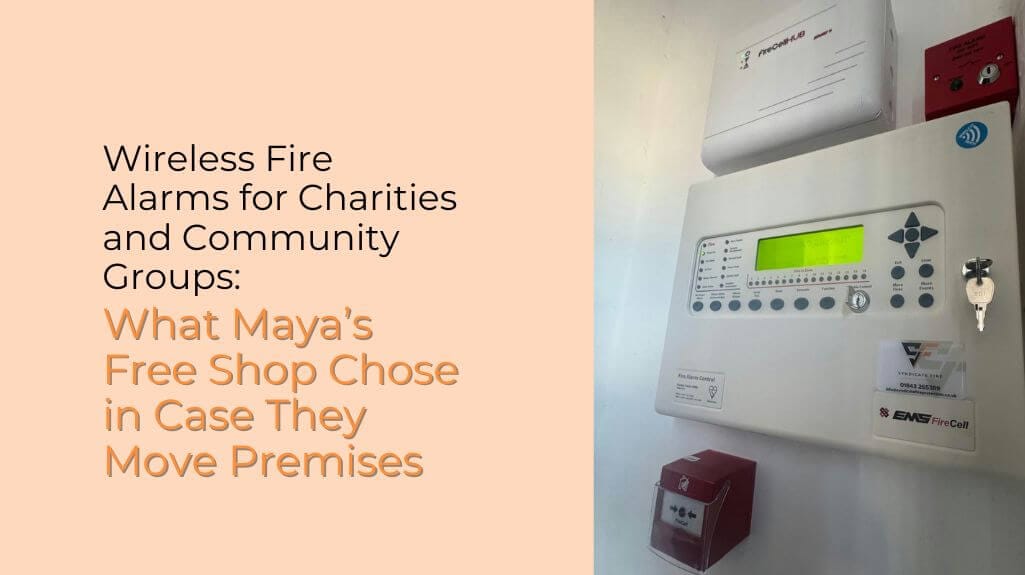
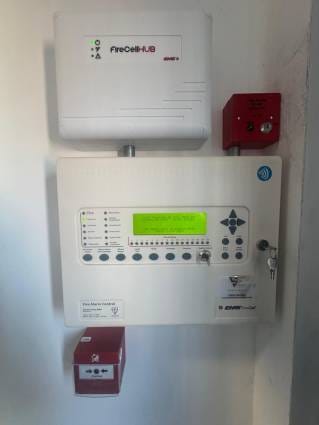
Syndicate Fire Protection Service installed the wireless Fire Alarm in July 2026. It is an EMS FireCell wireless Fire Alarm control panel with a FireCell HUB.
The system also has FireCell manual call points. These are the points people use to raise the alarm by hand.
Maya's written testimonial on the work, which she approved:
The team was professional, knowledgeable and took the time to explain everything clearly
The installation was completed efficiently, with great attention to detail, and everything was left clean and tidy.
Maya, Maya's Community Support Centre Warehouse Free Shop, Herne Bay
Wireless Fire Alarm for charities, community groups and tenants
The same question applies to any tenant with a Fire Alarm fixed into a building it does not own.
Leases end, premises become too small and funding periods finish. A Fire Alarm decision made today has to make sense for your next building as well as this one.
If you lease a shop, unit or office, or you rely on grant funding, it is worth asking these questions before you choose a system:
- Who owns fixed equipment in the building under your lease?
- What does your funding agreement say about assets bought with the money?
- If you move, who surveys the new premises and recommissions the system?
- Does the new building have a suitable mains supply for the control panel?
Wireless is not the only answer. It is, though, a sensible option to discuss if a move is likely.
The other wireless job we have written up is in Sandwich. The reason there was different: a finished building after a care conversion.
Talk to us about your Fire Alarm
If you are looking for a Fire Alarm in Herne Bay, or the towns around it, we're happy to talk it through. You can read more about our Fire Alarm Systems first if you prefer.
We are Syndicate Fire Protection Service, based in Ramsgate and on your doorstep across Kent. We offer a free, no-obligation site survey across Kent and London, so there is no pressure to decide anything on the day.
Call us on 01843 265 389 or use our contact page. Tell us whether you rent, whether you're funded and whether a move is on the cards.
Frequently asked questions
What happens to a Fire Alarm if an organisation moves?
A Fire Alarm wired into a building is usually fixed there, so a move can mean starting again. Whether the equipment is yours to take depends on your lease and your funding agreement. Check both before you move. A wireless system may be easier to take with you, but it still needs work at the new building.
Does a wireless Fire Alarm still need mains power?
On our Herne Bay job, yes: the control panel is powered from a fixed mains supply. The devices talk to the control panel by radio rather than through cable, so there is far less cabling than a wired system of the same size would need. Any new premises would need a suitable mains supply for the panel.
Can a wireless Fire Alarm be moved to new premises?
It may be, depending on your lease and funding agreement. Our advice is that a moved system needs a fresh survey of the new building. It may need extra devices, and it needs testing and commissioning for that building. A moved system will not necessarily work unchanged in a new building. That advice is ours. BS 5839-1:2025 is the current British Standard code of practice for the design, installation, commissioning and maintenance of Fire Alarm Systems in non-domestic premises.
Is a wireless Fire Alarm suitable for premises you rent?
It can be a sensible option to discuss, especially if a move is likely, because the devices use radio rather than cable. Wireless is not the only answer. We offer a free, no-obligation site survey across Kent and London if you would like to talk it through.
This article is provided for general information and educational purposes only. It is not legal advice, a fire risk assessment, a compliance audit, a technical specification, or a substitute for advice based on inspection of your premises. You should not rely on it as the basis for taking action, delaying action, or deciding not to act. Your legal duties, fire safety arrangements and system requirements depend on your specific premises, use, occupancy, risk profile and the findings of a suitable and sufficient fire risk assessment.
Fire safety and security legislation, standards, guidance and enforcement practice can change. Syndicate Fire Protection Service makes no representations or guarantees, express or implied, that content on this site is accurate, complete or current. For practical advice about fire alarm systems, emergency lighting, security systems or system maintenance requirements for your premises, call Syndicate Fire Protection Service on 01843 265 389.
For legal advice, fire risk assessment advice or confirmation of your statutory duties, speak to an appropriately qualified legal adviser, competent fire risk assessor or competent fire safety professional.